

I will now look back on a memorable training trip from nearly a year ago and share my travelogue.
What comes to mind when you hear "safflower"? For me, it's health foods like medicinal safflower oil and circulation-boosting herbal tea, as well as dried flowers. To my embarrassment, if someone asked me about safflower dyeing, my knowledge was limited to thinking, "Well, it's called safflower, so maybe it dyes things red?"
Upon researching it, I discovered it's a very historical botanical dye, and I joined the trip with great anticipation.
1. Safflower, Yamagata's Pride
Yamagata Prefecture boasts the highest production of safflower in Japan, and it is also the prefectural flower. Upon arriving at Yamagata Station, I was delighted to see safflowers displayed, with photos and a brief history, as if the safflowers were welcoming me with a "Welcome!"


By the end of the training, I understood the immense wealth, culture, and traditions that safflower had brought in the past, and it became clear why it is a Japan Agricultural Heritage site, a Japan Heritage site, and why it is currently applying for World Agricultural Heritage status.
Safflower originated in Israel and arrived in Japan in the mid-3rd century. During the Heian period, it was called "Suetsumuhana" and was an elegant flower that became one of the chapter titles in The Tale of Genji. Cultivation in Yamagata began in the late Muromachi period, where it was highly valued as a dye for aristocratic clothing and as lipstick, reaching its peak in the Edo period. It suffered a major blow in the Meiji era due to chemical dyes and the import of Chinese safflower, and it seems to have temporarily died out after World War II. It was revived from seeds discovered after the war and continues to this day.
2. Safflower Culture Supported by Yamadera Temple
It is said that Yamadera Temple (Risshakuji Temple) was deeply involved in safflower cultivation and trade, bringing immense wealth and culture to this region. Therefore, visiting Yamadera Temple became the starting point of our journey.


Yamadera, a scenic spot with a thousand-step stone path winding through lush trees and strange rock formations, is one of Tohoku's leading sacred sites, where the entire mountain is considered a temple.
In the main hall, there was an "immortal lamp" that has been burning for over a thousand years, having been re-lit from Enryakuji Temple on Mount Hiei. The stone steps leading from this temple gate are said to be a path of ascetic training where one's worldly desires disappear with each step climbed. At the top of these steps is a hall (Godaido) built on a cliff, offering a panoramic view. While all the staff were deeply moved, I, at my heaviest at the time, and with light rain falling, gave up less than a thousand steps in due to exhaustion... I couldn't get rid of all my worldly desires. That's me (lol).
Safflower cultivation seems to have begun in the early Edo period on the temple lands established by the six retainers who accompanied Jikaku Daishi, the founder of this temple. The fertile land along the Mogami River and the climate prone to morning mist provided ideal conditions for cultivating safflower, leading to widespread cultivation and making it the top safflower producing region in Japan.

Harvested safflower was processed into "beni-mochi" (safflower cakes) rolled into cracker-like shapes at the safflower merchants' houses, then transported upriver via the Mogami River to support the elegant Kyoto culture as crimson dye and rouge. This led to the emergence of wealthy merchants and farmers, known as "beni-daijin" (safflower magnates). During this era, the price of crimson was a hundred times that of rice and ten times that of gold. It generated enormous wealth, and it is said that they built residences to flaunt their riches. Many white-walled storehouse residences, which vividly preserve this trade culture, still remain today, and elegant Hina dolls and court dances performed in safflower-dyed costumes are passed down, adding a touch of splendor.
3. Matsuo Basho's Safflower Haiku
~Safflower that added color to the lives of commoners, not just the wealthy~
During the Genroku era, when Matsuo Basho visited Yamadera Temple, he composed the famous haiku, "Silence—
Seeping into the rocks,
Cicada's cry," which he left in his "Oku no Hosomichi" (Narrow Road to the Deep North). He also composed two haiku upon seeing safflowers along the way. One is "A brow brush, its image / In the face of the safflower." This implies that the safflower, which would eventually color a woman's lips, also resembled a brow brush (a small brush used to dust off powder after applying white makeup) used in women's cosmetics. It is said to depict the alluring crimson and lips of a Kyoto woman.
Of the two haiku, I much prefer "Whose skin will touch it in the future, this safflower?" although it was not left in the "Oku no Hosomichi" collection. It is said to express the feelings of the peasant daughters who diligently picked safflowers, yet were never able to apply rouge to their own lips in their lifetime. They might have wondered, "Whose skin will this safflower I'm picking touch in the future? It will surely be a pretty girl, and I, too, would like to try applying rouge at least once."

It is said that the flower-picking girls of that time used the wastewater from processing safflower into dye to color cloth, making safflower-dyed items that added a touch of beauty to their modest lives. I believe such ingenuity and resourcefulness are the wisdom we, who live later, should inherit.
4. Off to the Safflower Museum
~Safflower: Good to see, good to dye with, good to eat~
Before experiencing safflower dyeing, I visited the Safflower Museum to touch and feel its history, and enjoyed viewing various exhibits.
The museum is located in Kahoku Town, and it was actually the former site of a wealthy merchant's residence, with a vast ground surrounded by stone and black plank walls.


First, I was overwhelmed by the safflower fields blooming around the museum. The thorny, thistle-like yellow-orange flowers were indeed "good to see." Within the grounds were several kura-zashiki (storehouse-style residences), where I could understand the history and culture brought by safflower trade (elegantly displayed with large and small Hina dolls, safflower costumes, etc.). The detailed process of safflower dyeing was also exhibited. The red pigment contained in safflower petals is, surprisingly, only 1%! I was deeply impressed by the meticulous and time-consuming process of repeatedly washing out the yellow pigment. And I was also moved by the beautiful red color achieved through safflower dyeing. It truly is "good to dye with." Furthermore, I learned that safflower has various medicinal properties, including antioxidant effects. Not only safflower oil, but also its leaves and flowers are used in medicinal cooking and as tea, making it a plant that is "good to eat." It goes without saying that I bought safflower tea and safflower soap because I want to be beautiful.
5. Finally, the Safflower Dyeing Experience!
~Safflower: A Mysterious Flower~
After immersing ourselves in the historical background and knowledge of safflower, it was finally time for the safflower dyeing experience. We had the opportunity to experience it at the home of Mr. Konno, who plays a central role in Shirataka Town, which boasts 60% of the prefecture's safflower production.

The program consisted of three parts: ① learning about safflower, ② picking safflower, and ③ safflower dyeing.
① Mr. Konno gave us a detailed explanation, including the history, of why Mogami safflower can be called a treasure of the world. We also learned that the safflower grown in Yamagata, with its wide temperature variations, produces a deeper red color. Safflower only blooms when the temperature is above 25 degrees Celsius. And, surprisingly, it blooms with just one single flower on the "Hangesho" zassetsu (a minor seasonal day) 11 days after the summer solstice. After that, flowers are said to bloom one after another as if following a leader. Locals call this "hange hitotsu-zaki" (one flower of Hange). What a mysterious flower it is!
② In the light rain, fully equipped with raincoats, boots, and rubber gloves to prevent thorns, we enjoyed picking safflower.

The safflower fields were filled with countless beautiful safflowers. The NONA staff stood side by side, picking hundreds of safflower petals each. It was such an enjoyable and addictive task. Perhaps it's the allure of safflower. The light rain didn't bother us at all.
③ Finally, it was time for safflower dyeing.
We couldn't do the entire process in one day, so we did a part of it.
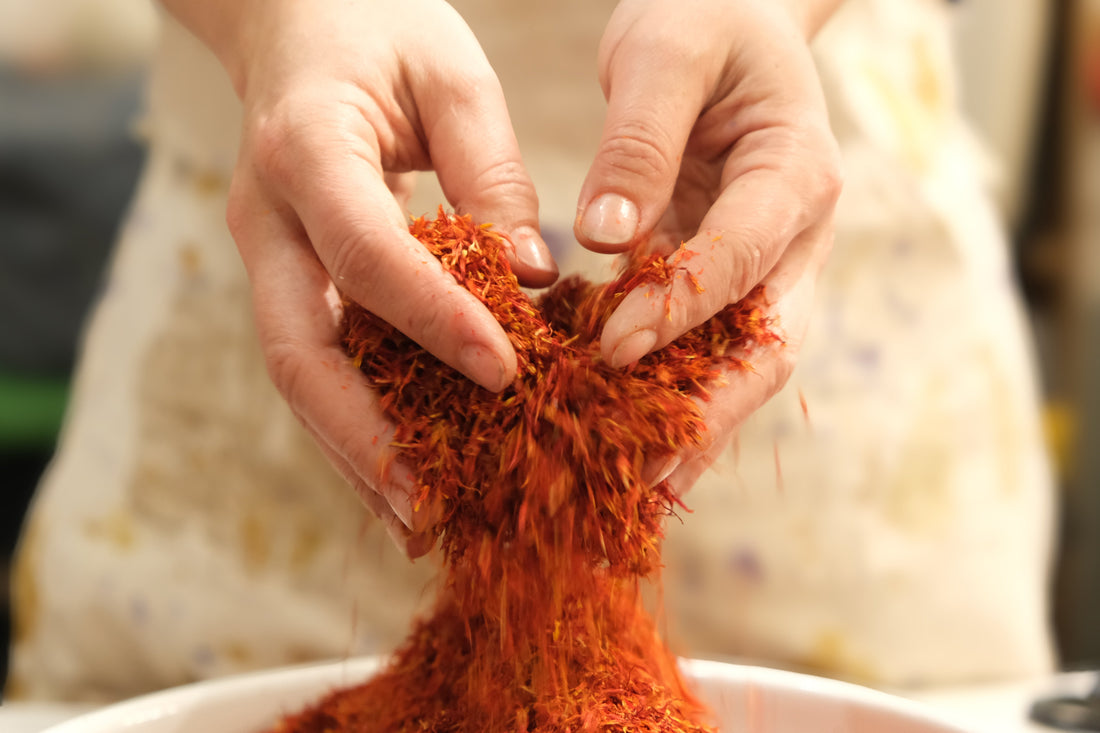
First, we washed the picked safflowers with clean water to remove dirt and debris. A faint, sweet fragrance wafted up. Then, we repeatedly kneaded the petals and rinsed them with water to extract the yellow pigment. The oil from the petals was so abundant that our hands became smooth. We only went this far. After that, they go through many more steps over several days to create a cracker-like shape, which is then sun-dried to make "beni-mochi," the base for dyeing.
99% is yellow pigment, and only a mere 1% is red pigment. The effort required to extract this rare red pigment is immense. It's understandable why it has been expensive, both then and now. Now! Finally, it was time for the dyeing process, liquefying the beni-mochi. Each staff member created their own unique dyeing by tying threads to make patterns and adjusting the soaking time.


Mr. Konno, full of love for Mogami safflower, is involved in a wide range of activities and is striving to make the wonders of Mogami safflower known to many people. He is also reportedly applying for World Agricultural Heritage status.
After promising to deepen our exchange, we presented a NONA temari, and the safflower dyeing training concluded.
6. NONA's "Nihon no Iro" (Colors of Japan)
~The Miracle of Safflower~
Through this training, NONA created delicate crimson threads. Since the red color is deeper in colder seasons, during this year's first dyeing, we repeatedly worked to extract the yellow color, layered the dyeing process, and brought out the crimson. It is the 1% miracle of safflower.
The changing seasons and mysteries revealed by plants are gifts from nature. It is one of NONA's important tasks to truly appreciate this mystery and to pass on the wisdom of our predecessors, who revived the life energy of plants as colors, so that it may not be lost.
NONA plans to gradually introduce more colors that we wish to preserve in Japan. Please look forward to them.
Mariko Hoshino, NONA Staff

